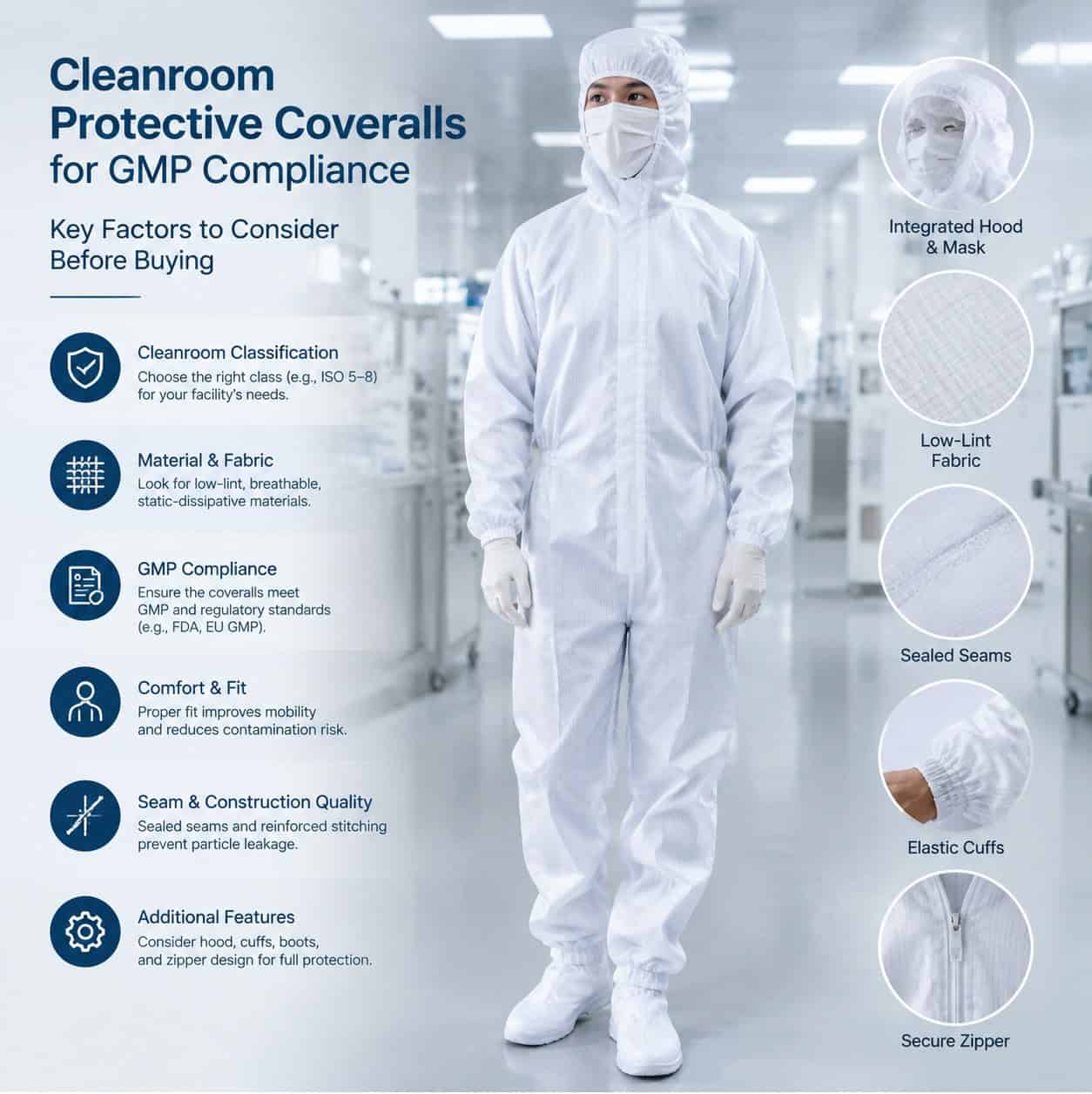
 A single lint particle in a sterile filling suite can cost more than the coverall budget for an entire shift. That is the uncomfortable math behind every GMP cleanroom garment decision. Cleanroom protective coveralls are not uniforms. They are part of your contamination control strategy, your sterility assurance program, and your inspection defense file. If you buy them like ordinary workwear, you will pay for it later in deviations, media fills, and auditor questions you cannot answer.
Start with the grade, not the catalog.
The first question is never “Which coverall is cheapest?” It is “Which coverall is validated for the area where it will be worn?” A Grade A or B sterile filling zone has different demands than a Grade C or D support area. ISO 14644 classifications, EU GMP Annex 1 expectations, and your own site contamination control strategy should define the garment’s particle shedding limits, bioburden limits, barrier performance, and sterility status. A coverall that performs well in a warehouse corridor may be a serious liability in an aseptic core. Buy for the cleanroom class, the operation, and the worst-case exposure, not for the average day.
Material and construction decide whether the garment helps or hurts.
Look beyond fabric weight. The material must be low-linting, durable, and resistant to the disinfectants and cleaning agents used in your facility. For sterile operations, the coverall must provide an effective barrier to microorganisms and particles while still allowing enough comfort for operators to work without constantly adjusting it. Seams, zippers, hoods, elastic wrists, thumb loops, and boot flaps are not details. They are contamination pathways. A weak seam or exposed zipper can release particles, trap contaminants, or fail during a critical intervention. If the coverall is reusable, the fabric must survive repeated validated laundering without losing its barrier or shedding profile. If it is disposable, it must be manufactured, folded, and packaged in a controlled environment that matches its intended use.
Sterility is a claim that requires evidence.
For sterile coveralls, the sterility assurance level, sterilization method, and validation package matter. Gamma irradiation, ethylene oxide, and other sterilization methods each have strengths and limitations. The method must be validated for the garment materials and packaging. It must not degrade the fabric, weaken the barrier, or leave residues that could affect the product or the operator. Ask for sterilization certificates, dose mapping, bioburden data, and lot-level traceability. A sterile label without a validated process behind it is just a label. In GMP manufacturing, the paperwork is part of the product.
Laundering and reprocessing can quietly undo a good purchase.
Reusable cleanroom coveralls live or die by their reprocessing program. Cleanroom laundry is not industrial laundry with a better name. It requires validated wash cycles, controlled water quality, filtered air, dedicated cleanroom dryers, and rigorous monitoring for particles, ions, and microbial contamination. The garment’s life cycle must be tracked. If a coverall has been washed too many times, its barrier may be compromised. If it has been repaired poorly, it may shed. If it has been mixed with non-cleanroom garments, it may never be truly clean again. Before buying reusable coveralls, audit the laundry partner. Before buying disposable coveralls, audit the manufacturing and packaging environment. Either way, you are buying a process, not just a garment.
Fit and gowning performance are compliance issues.
An uncomfortable coverall is a nonconforming coverall. If operators are hot, restricted, or worried about tearing the garment, they will break gowning technique. They will touch the outside. They will adjust the hood. They will skip a step. That is how contamination happens. The coverall should fit a range of body types without being so loose that it snags or so tight that it restricts movement. It should be easy to don without touching the exterior. Hoods should seal well with masks and goggles. Wrists and ankles should close cleanly. Consider a gowning trial with real operators in the real cleanroom, not a conference room. Watch how they move, stretch, bend, and work. The best coverall is the one your team can wear correctly for an entire shift.
Documentation and supplier qualification separate serious vendors from catalog sellers.
Your supplier should provide technical dossiers, certificates of analysis, particle and bioburden test reports, sterilization records, and change control notifications. They should understand EU GMP Annex 1, ISO 14644, ISO 11137, and the relevant cleanroom garment standards. They should be able to support your validation and audit needs without scrambling. Ask what happens if they change a fabric, a seam, a sterilization dose, or a manufacturing site. If the answer is vague, that is your answer. In GMP, an unnoticed supplier change can invalidate your gowning qualification and trigger a deviation. Buy from a partner who treats change control as seriously as you do.
Calculate cost per compliant use, not cost per coverall.
The purchase price is the smallest number in the equation. Add laundering, sterilization, validation, quality control, inventory, waste, training, and downtime. Add the cost of a single contamination event. A cheaper coverall that tears, sheds, or fails an audit is not cheap. A premium coverall that lasts longer, reduces gowning errors, and comes with defensible documentation may cost more per unit and far less per compliant use. Procurement should not make this decision alone. Quality, operations, and microbiology need a seat at the table.
The human factor is the hidden variable.
No garment can compensate for poor gowning training or a broken quality culture. But the right garment makes good behavior easier. It reduces excuses. It supports repeatability. It gives auditors confidence that your contamination control strategy is not theoretical. When operators trust their coveralls, they focus on the product. When they do not, they improvise. Improvisation in a cleanroom is just another word for risk.
Before you sign the purchase order, ask for samples, run a gowning trial, review the validation package, and visit the manufacturing or laundering site if you can. Ask the hard questions about particles, sterility, traceability, and change control. Then choose the coverall that protects your product, your people, and your compliance position. That is not a purchasing decision. It is a quality decision. And in GMP manufacturing, quality decisions are the only ones that matter.
About the Author